by: Akram Abdulhafedh
The issue of migration is amongst the most controversial economic and political topics due to its direct relation with sensitive political, historical and humanitarian issues. Politically it links to issues of population diversity planning, issues related to international relations and trade, and at times observed as a demagogue tool to win votes in elections ! Historically, related topics about migration could be found when examining issues of forced displacement, slavery and natural disasters. We also find the humanitarian studies relates to the topic of migration when discussing the impact of wars, the importance of rights, freedom and asylum topics. The issue of migration has always existed ,perhaps since the beginning of time, and judging from the current global attitudes and point of views of people towards it one can almost be certain that the issue of migration has always been misrepresented. It is a paramount task for an ordinary economist to reinterpret the issue of migration in a manner that brings sane understanding to the misconceived intellect. I would have the pleasure to do so in my country Yemen, starting with you dear reader.
According to United Nations statistics, there are roughly 244 million immigrants in the world , most of them are in Europe. Yemen has about 1.2 million immigrants (pre-war stats in 2014), most of them in the Gulf states; 586,000 in Saudi Arabia, 173,000 in the UAE, 65,000 in Kuwait, 35,000 in Qatar and 15,000 in Bahrain. The United States and Britain are also a common destinations for many Yemeni expatriates, with immigrants estimated at 41,000 and 20,000 in US and UK respectively. However, these data may be incomplete because a large number of Yemenis often carry a US passport before traveling to the United States due to marriage or family reunion.
Yemen is also home to some 300,000 immigrants, mostly Somali nationals and Sudanese, Egyptian, Palestinian and Iraqi nationals.
Logically, people tend to assume, specially locals, that immigrants bring damage to their local economy. This is true, but to a certain extent. To a rather far extent many citizens often ignore the benefits that immigrants bring to the economy. I will try to underline some of the damage and economic benefits of migration on the sender and the receiver country , but first we ought to explain the types of migrations a better understanding of damage and benefits.
The purposes for people traveling abroad for a long period of time are mostly for ; employment, study (self-development) , displacement, asylum, and investment. The economic returns for each of the previous categories vary and so does the damage. The motives for migration are always economic, except in the case of asylum and displacement, their grounds are political. The motive behind employment migration is the result of the disparity in the strength and weakness of currencies between countries and the rate of unemployment. For the self-development migration, the motive could be observed as a personal investment in the development of the individual’s human capacities. It could also be a development of one’s capital , as many investors migrate to different countries to seek governments that could give them a better investment environment with greater returns and suitable commercial laws. Meanwhile ,migration with political incentives vary, but often as a result of actions and externalities outside the will of the individual which compel them to search for a home that offers protection or compensation for losses resulted from natural disasters.
Knowing the drivers of migrations helps us to control the proportion of immigrants, especially with economic ones. The rise in currency strength reduces the labor migration rate, while a reduction on investment taxes, reduces the proportion of investors immigrating to invest abroad. Lowering currency strength could give lower incentives for employment migration and increasing unemployment-benefit or asylum wages could raise the number of political migrants.
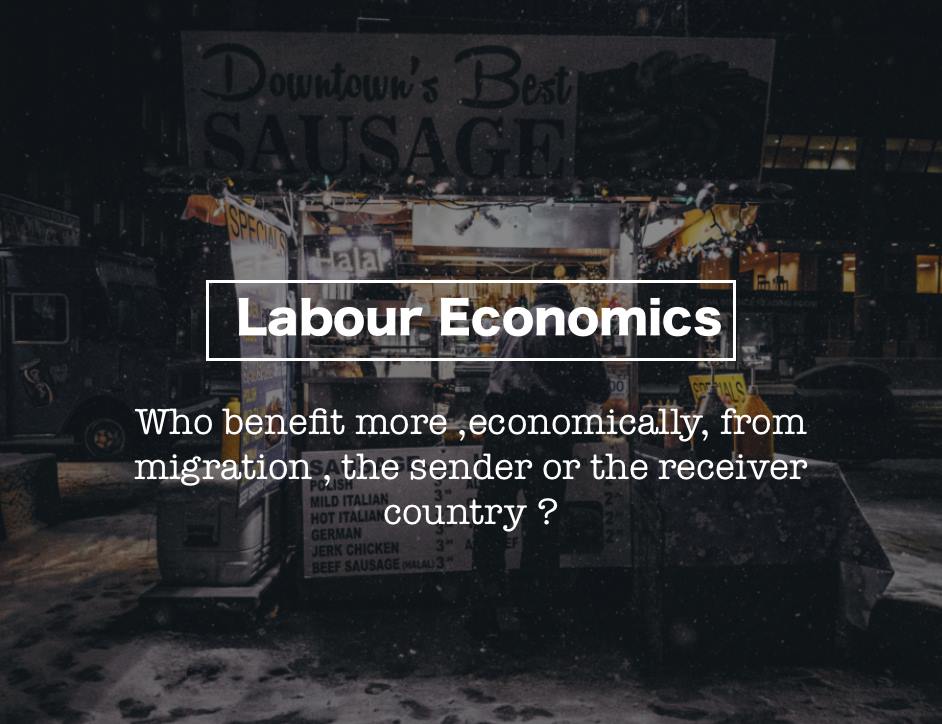
The most controversial aspect concerning migration is the labor migration. Economist debate about who benefit the most from migration ,the labor-exporting country or the receiving country. There are a numerous number of researches that investigate into this matter and there is almost a consensus that the receiver country is the biggest winner, however there are still individual cases of some countries that shows a negative signals for the receiver country. Therefore, it is always better to investigate this topic in a case-by-case manner. Lets take the example of Yemen and Saudi Arabia.
Let us assume that we have two states; Yemen and Saudi Arabia. The density of skilled labor in Yemen is greater than Saudi Arabia, but Saudi Arabia’s currency is stronger than the Yemeni currency. Let’s look at the restaurants industry for simplicity. We assume 3000 skilled cooks in Yemen, each receives $ 600 per month salary. Saudi Arabia has 1,000 skilled cooks, but each receives $ 1000 a month.
In normal economic conditions and with no restrictions on labour or capital mobility between the two countries, labor forces migrates from Yemen, which has a high density relative to Saudi Arabia, which has low density of skilled labour and high wages. This leads to a decline in the labor force in Yemen to only 2000 workers, which in turn raises wages and pensions due to the low supply and an increased demand for Yemeni labor in Yemen. In the other hand, Saudi Arabia; due to the entry of 1000 workers to the market, demand drops and supply of cooks increases, leading to lower wages. In normal circumstances, migration is supposed to stop when wages are equal, but often it does not due to spill-over effects, which suggest that the labor force that migrated to Saudi Arabia if they did not find a job in cooking they would look for work in other markets.
In the circumstances described above, we have 4 affected ; the two countries ,employers and workers, and the amount of benefit and damage are as follows:
-Business owners in Saudi Arabia: The owners of restaurants in Saudi Arabia benefit from low wages and the availability of skilled labor at a lower cost, giving them the possibility of reducing the price of meals they offer to customers.
-Businessmen in Yemen: Employers in Yemen are affected by rising wages in Yemen and the scarcity of skilled labor.
-Labor: The immigrated labor force benefits from wages differences , while labor forces in Yemen benefit from low competition and potentially high wages. However, local workers might be negatively effected from raising competition and lower wages.
The two economies; Yemen and Saudi Arabia: Yemen is benefiting from the expatriate remittences as a form of hard currency source and also the development of labour skills and capital with a potential lower unemployment rate , but it suffers from brain drain which makes businesses less efficient and reduce development. Saudi Arabia is also benefiting from an increase in skilled labor and private sector growth. Employment-gap is fulfilled and locals benefit from vibrant communities and different cuisines in there local towns. However, Saudi economy suffers from higher unemployment rate in the long run and higher job competition and at times certain locals could develop negative attitudes towards foreigners due to extensive worries of over-crowdedness creating a cases of xenophobia. Saudi economy would also have to spend more on security.
The Gulf crisis in 1990 was a great example that shows the economic impact labour migration for both the labor-exporting country and the importing country. After the sudden imposition of the sponsorship system on Yemenis workers, which forced foreign investors from Yemen to have a national partner, many of the expatriates in Saudi Arabia rushed to sell their businesses mostly at very low prices seeking national partners and others who couldn’t were forced to return to Yemen, an estimated 800 thousands immigrants where returned to Yemen reported by the UN causing a damage of roughly 10% Of the GDP at the time ($ 1 billion), most of which was due to the drop in remittences transferred to Yemen. Although the negative effects of the Yemeni economy were enormous, there were several positive indicators that underlined the economic development obtained from returned workers specially concerning the development of the Yemeni private sector. This is due to the fact that Yemen was not suffering from high unemployment at the time, but on the contrary, at the same year, the Yemeni unity between the South and the North on May 1990 had created many business opportunities, especially in Sanaa, Aden. Expatriates returning from Gulf countries with large savings in hard currency were able to set up their small and medium enterprises, benefiting from the skills and expertise they acquired.
From this basic example we could see that there is always benefits and negatives distributed between the two sides and it is always a mistake to generalise or assume that migration is bad or good as an absolute for one country’s economy. There is however one thing that we could be absolutely positive about which is the fact that remittences are what makes a genuine positive difference in developing low income economise and reducing global poverty. We would write more about the issue of migration and other economic issue in a biweekly basis in my blog. Feel free to comment and share your thoughts about the issue of migration
 Qalansiyah
Leave a comment